Story
How we came to exist. What we believe. Why we make music.
The Name
Rootwater. Two elemental forces. The root that anchors. The water that flows.
The root is tradition — the foundation of reggae, the lineage of resistance music, the rhythms that came before us and will outlast us. It is what holds us in place when the world tries to wash us away.
The water is change — the river that runs through all things, the frequency that connects every particle in the universe, the current that carries the music from here to there, from then to now, from one heart to another.
You cannot have one without the other. A tree without water withers. Water without roots has no direction. Together, they become something alive. Together, they become this.
The Philosophy
There is a frequency underneath the frequency. A pattern beneath the pattern. What Bob Marley sang in 1973, quantum physicists proved in 2011. What the mystic knew by feeling, the scientist confirmed by measurement.
We make music at the intersection of testimony and data. Marley never cited a statistic, but every lyric he wrote was later confirmed by one. He sang truth so pure that the numbers had no choice but to agree. That's the frequency we chase.
Reggae has always been a theory of everything — cosmology dressed as a riddim, economics hidden in a bassline, liberation theology wrapped in three chords and the truth. We didn't invent this. We just remembered it.
This music is not entertainment. It is testimony. It is data. It is the sound of a world waking up and realizing the boundary between self and universe was never a wall — it was always a window.
The Sound
One-drop riddim. That's the foundation. The heartbeat. The cosmological constant. The moment the drum hits on the third beat and the entire universe remembers what it was before it became matter.
We record live. Real horns. Real drums. Real bass. Analog dub delays that trail off into infinity. No quantization. No auto-tune. No perfection. Just the sound of human beings in a room, breathing the same air, locked into the same frequency.
We use world instrumentation — kora from West Africa, tabla from India, steel pan from the Caribbean — not as decoration, not as exotic spice, but as proof that every culture already knows this frequency. They just call it by different names.
Our engineers are dub scientists. Our mixdowns are arguments. Every reverb tail is a philosophical position. Every bassline is a manifesto. We are making music for the moment when you close your eyes and remember you are made of the same material as stars.
The People
Rootwater Collective is not a band with members. It is a rotating constellation of musicians, vocalists, producers, spoken word artists, and mystics who all heard the same frequency and followed it here.
There is no frontman. No hierarchy. No ego. The music is the leader. The riddim is the boss. We are all servants of the frequency. Some of us play horns. Some of us play bass. Some of us play the silence between the beats. All of it matters equally.
We believe in community over celebrity. In collaboration over competition. In the collective breath over the individual voice. When you listen to our albums, you are not hearing a band. You are hearing an ecosystem.
We come from Brooklyn, Kingston, Addis Ababa, Mumbai, Salvador. We speak different languages but we all speak riddim. We worship different gods but we all bow to the one-drop. We are the proof that music is a universal language — not because it transcends difference, but because it celebrates it.
The Founder
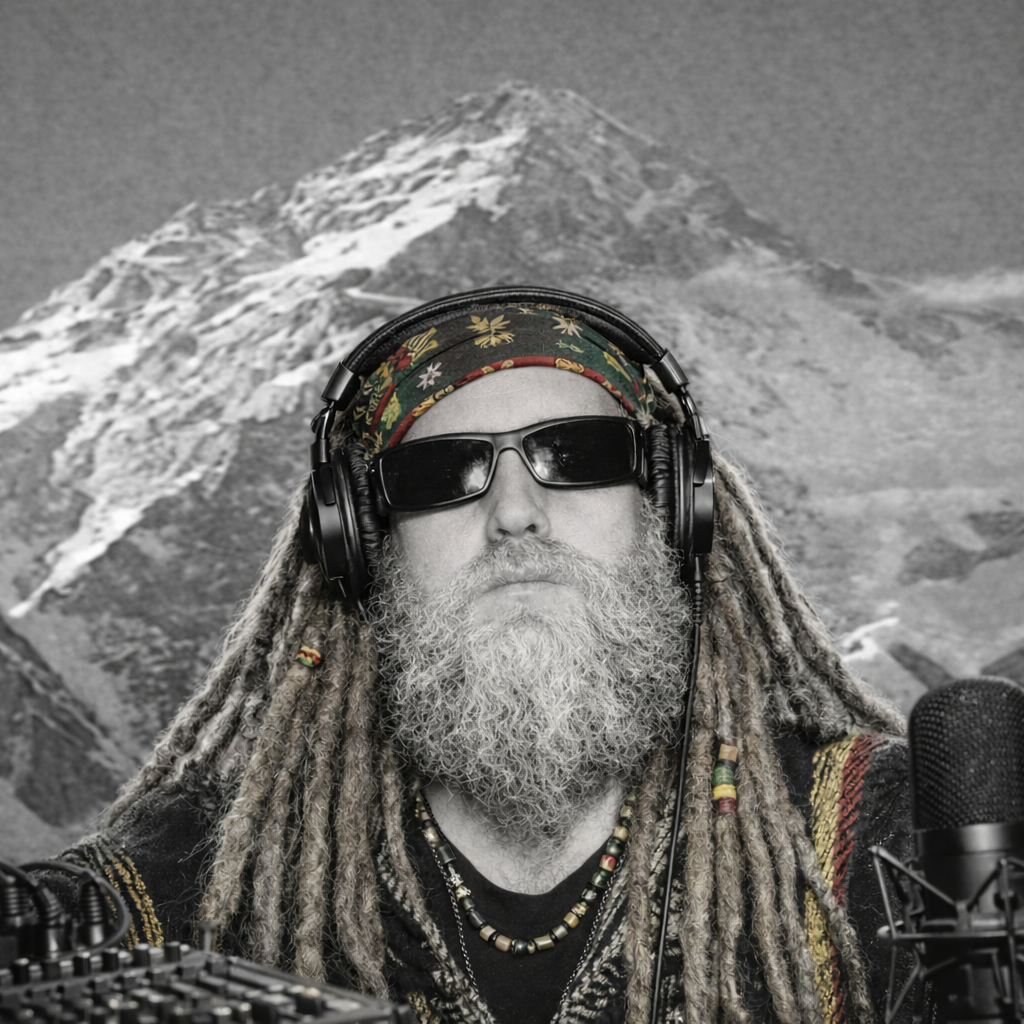
Tom Westlund
Tom Westlund is the founding force behind Rootwater Collective — a seasoned sound engineer who has spent decades listening for the frequency underneath the frequency.
Tom's path began in the studio, behind the console, shaping the sound of artists who trusted him with their most unguarded moments. Over time, he came to believe that sound engineering is not a technical discipline — it is a spiritual one. That every frequency decision is a philosophical position. That the board is an instrument and the mixer is a musician.
He built Rootwater Collective on that conviction: that the right people, in the right room, tuned to the right frequency, can make music that shifts something in the listener. Not just emotionally — physically. Molecularly. At the level of vibration where science and testimony stop arguing and start agreeing.
Tom does not perform. He architects. He is the reason the drums sound like that, the reason the reverb tails off exactly when it should, the reason the collective sounds like one organism breathing in unison. He is the invisible root beneath the music.
The Albums
Rivers & Roots is the album where we looked outward. Twenty songs about systems — economic, ecological, cosmological, spiritual. Every track is a different lens on the same truth: that everything is connected. That the river runs clean when the frequency is pure.
It's the sound of reggae remembering it was always a theory of everything. Bob sang it. Peter sang it. Burning Spear sang it. We just made it explicit. We made the physics audible. We made the data sing.
The Inner Meridian is the album where we turned inward. Twelve songs about the cartography of consciousness. About the meridians that run through us. About the mirror that opens when you stop trying to see yourself in it.
If Rivers & Roots was cosmology, The Inner Meridian is anatomy. If the first album was the universe, the second is the breath. Twelve tracks recorded in a single room with all musicians present. No headphones. No separation. Just the sound of being in the same space, listening to the same silence.
Both albums are part of the same transmission. Both are saying the same thing in different ways: The boundary between you and the universe is not a wall. It's a window.